An interview with Simon Gresty, Chairman, Can Makers

On behalf of the International Canned Wine Competition in California, I had an interview with Simon Gresty, Chairman, Can Makers.

A gold sponsor of this year’s International Canned Wine Competition, the Can Makers is the trade body representing drinks can manufacturers in the UK.

Members work together specifically to promote the benefits of the drinks can and aid communications between the industry and its customers: the brewers and soft drinks manufacturers and the retailers, as well as the packaging industry, the media and consumers.

The UK is the largest beverage can market in Europe, with over 10 billion cans shipped each year from UK can manufacturing plants. The Can Makers was the first organisation in Europe formed to promote drink cans. It is part of the Metal Packaging Manufacturers Association which represents the UK metal packaging industry.

Thanks for taking the time to speak with ICWC Simon. Can you tell me a little about yourself and your background?

In addition to my position as chairman of the Can Makers, I’ve now held my current role as General Manager at Ardagh for five years, overseeing all aspects of the business.

 I’ve worked in the industry for more than three decades, as an account manager in the early days before taking on commercial roles in sales and business development and then general management.

You were previously chairman of the Can Makers between 2006 and 2008. How has the industry changed since then?

There have been many changes of significance for the industry in the last 15 years, such as the shift in focus from printing capability to sustainability, with all its implications throughout the value chain.  And you have to remember that the colours we see on cans now, the creative designs and branding opportunities that are now a key differentiator when choosing to package wines or any beverage in cans, would have been unthinkable little more than a decade ago.

The metal beverage can industry has had to continually reinvent and adapt to market conditions in that time and adaptability is now a constant requirement. Increasing levels of operational versatility will therefore remain a key challenge for industry in the years ahead.

Why did you choose to support the ICWC?

The Can Makers Committee brings together stakeholders throughout the value chain from manufacturers to suppliers of raw materials and the Committee’s work proactively supports numerous environmental and technical initiatives as well as marketing campaigns to promote the can.

The fact is that canned wine is fast becoming big business. The UK market is now worth more than £3.6 million – an annual increase of 125% to August 2019, while the global canned wines market is expected to reach USD 155.1 million by 2027.

But despite this growth and the environmental benefits the can offers, there remains a perception among some that canned wine is somehow inferior.

Supporting ICWC is just one way in which the Can Makers is helping to change consumer and brand perception and drive growth in this category. It also follows Can Makers work with a number of leading wine critics, whom we invited to participate in a virtual wine taste test. The results were extremely encouraging and many of the wines continue to feature in the national press following endorsement by the critics.

Initiatives like this all make a significant contribution to normalising new formats and ensuring the merits of the can are considered by all beverage producers.

What does the future hold for canned wine?

In recent years we’ve seen a major shift in the types of beverages packaged in cans. As brands diversify, so the format itself has adapted.

The 330ml can has undoubtedly underpinned the rise in craft beers while sleek and slim cans are increasingly popular with premium brands for high quality wines as well as spirits and mixers.

A natural progression in this development, and one which I am keen to drive as far as possible during my time in office, is the perception of the can as a format which offers real prestige, as well as performance and convenience.

There is no doubt in my mind that the popularity of wine in cans will continue to grow. We are already seeing high quality brands launching exclusively in cans which simply would not have happened just a few years ago.

And for the sustainably conscious consumer, the canned format is ideal. Cans are light, convenient and easy to recycle. Aluminium cans are also the most recycled beverage container in the world and can be recycled forever without any loss of quality. This sustainability message is only going to become more important for brands in the years ahead.

The Can Makers will therefore continue to focus its communications activity on driving awareness of the benefits beverage cans offer throughout the value chain, from brands to consumers.

Californian (canned) wines made by Canadians

In these series of interviews I will interview many enthusiastic people who are involved in the canned wine business.

With whom do I have the pleasure of speaking?

Justin Dumitrescu and Chris Noll, Founders of STEL+MAR.

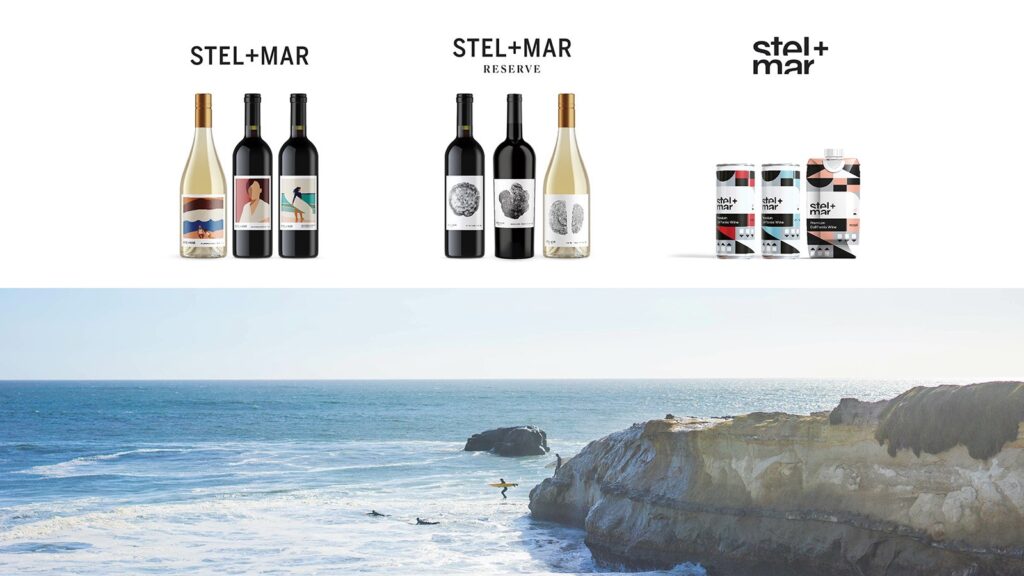
Our wine brand is the result of two friends and their families coming together to make crowd-pleasing and award-winning California wines. The name is derived from their kids, Stella and Marcus, and a brand name was born. Our combination of amazing wine and label art has resonated with consumers around the world.

What is your background in wine?

We’ve been in the alcohol industry for several years starting with cider, which is similar to wine. We are both big wine lovers and have always wanted to get into wine.

How would you DESCRIBE your wine in a can?

Better than what’s in most bottles at similar values! Our wine in can is single varietal and single ava. Low sugar (less than 3g / L). We let the terroir speak for the wine—nothing added to the wine.

Each year we personally select the best lots from each harvest; we focus on wines that are single varietal, unadultered and above all, showcase the winemaker and wine region. We enter each year both optimistic and opportunistic; paying obsessive attention to the weather, the rain, cool nights, and the delicate harvest. Growing up in Canada and being driven by the changing seasons, we see vineyards in a similar light with their distinct cycle of growth, harvest and rest.

Our red is a 100% Zinfandel from the magnificent Lodi AVA.  A classic Lodi Red Zinfandel! A robust wine packed with ripe fruit (cherries, cassis, and blackberries) yet enough acidity to give it lift. The rich berry flavours are highlighted with subtle hints of chocolate and vanilla that do not overpower. Finished with ripe tannins. This medium-bodied Zinfandel pairs beautifully with lamb, grilled beef, and pizza.

Our white is a 100% Chardonnay from Mendocino. This beautiful Unoaked Chardonnay offers aromas of Anjou pear, nectarine, and green apple. The palate shows ripe orchard fruit and citrus flavors that are light and lively, backed by bright acidity. Vanilla minerality with some lingering toffee tones. This fruit-forward Chardonnay pairs beautifully with fish, grilled chicken, and sushi.

‘The Zinfandel is absolutely mind blowing! Spicy, black and red fruit combined with acidity. The wine lingers long and it must be said that having a high quality red canned is a hard job, but at STEL+MAR they did it!’

‘The unoaked Chardonnay does not smells like an unoaked….the vanilla and caramel gives a small nod to wood aging, but that is not technically the case. It is a wine with a good body which can be enjoyed ‘stand-alone’ or combined with lot’s of food, due to its gastronomic character’

Why are you in the canned wines industry?

We think canned wine is the next major innovation in wine. Similar to twist-off tops, it will take a few years for people to get past their inherent biases.

How do you see the future of canned wines?

Bright! Millennials will be quick to adopt canned wine followed by the older demographics. There’s no good reason why canned wine won’t represent 10-20% of the total wine market in 5 to 10 years.
We also package wines in tetra pack boxes and light glass bottles. We aim to make crowd-pleasing wine at good prices with beautiful label art, all packaged in environmentally-friendly packaging options.

Tetra pack boxes

Canned wines from NY!

In these series of interviews I will interview many enthusiastic people who are involved in the canned wine business.

With whom do I have the pleasure of speaking?

My name is Aimée Lasseigne New and I am the New York City Brand Ambassador for Lieb Cellars,which is a 22 hectares, certified sustainable, winery on the North Fork of Long Island, NY and also our second label Bridge Lane Wine which specializes in craft wine offered in bottles as well as alternative formats.

Aimée Lasseigne New

What is your background in wine?

I worked in fine wine retail for 14 years and have also served in restaurants.  I was selected twice to compete in the StarChefs Somm Slam at the International Chef Congress, have been a FICOFI guest sommelier, and my piece “The Struggle for Sweet” was selected as a placing entry for The Feiring Line Writing Mentorship Award. I am a graduate of Louisiana Scholars’ College, recognized as a Certified Sommelier by the Court of Master Sommeliers, and a Diploma Candidate of the Wine & Spirit Education Trust (WSET).  

As a freelance wine and spirits judge I have served on panels both locally and internationally in Paris, Beijing, Spain, Bulgaria, and Switzerland in addition to having visited vineyards across New York, Napa, Portugal, Bordeaux, Italy, and the Republic of Georgia.

How would you describe your wines in a can?

Bridge Lane is unique in that our wines are available in four sizes: 750ml bottles, 3L Bag-in-Box, 19.5L kegs, and 375ml cans.  We were the first in NY to offer wine in cans.

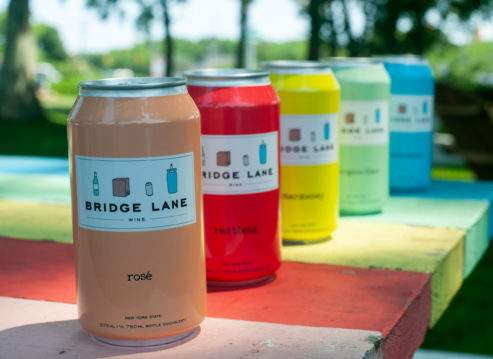
The canned wines range of Bridge Lane

Our rosé is the most popular.  It is dry, known for its crisp acidity and is Cabernet Franc based with notes of strawberry, peach, and watermelon. Our Chardonnay is unoaked with notes of lemon, pear and green apple.

If you don’t like Chardonnay, you will now! Great fruitiness and wonderful layers of aromas and what an aftertaste!

We have a rather unique wine – White Merlot which is actually a white wine made from Merlot grapes with no skin contact. There are notes of ripe honeydew melon and lime with an apple peel finish.

First time I tasted a White Merlot wine. Absolutely amazing and unique in his kind. Tropical fruit and little berries arise from the glass and the can. Without a doubt a great wine with potential in a can!

Our Sauvignon Blanc has freshly cut grass and floral aromas and a citrusy finish.

This is really what you would expect from a Sauvignon Blanc from this part of the world. Crispy, juicy and great acidity!

Our Red Blend is mainly made of Merlot with notes of black cherry and spicy cedar and spends 6 months in Hungarian Oak.

A BDX blend as it should be with a lot of ‘over sea’ freshness, which referring to the cooling ocean influence preserves the fresh acidity in the wine.The wine has got depth and notes of dark fruit and a balance between acidity and fruitiness. This is an example of a great red wine in a can!

We do have a 6th Bridge Lane wine, and it is available only in cans – our Bridge Lane Bubbles which was first released in 2020.  It is mostly made of Riesling with notes of tangerine, honey, and jasmine.  Unlike our other wines which are dry this wine has a little residual sugar to balance the zippy Riesling.

Why are you in the canned wines industry?

Our General Manager, Ami Opisso discussed this with me recently.  They had talked about cans in 2014 when they rebranded Bridge Lane and launched boxes and kegs because it was logical to include cans as a part of our alternative format focus, and as she said, “because we wanted to bring them to the beach” but she quickly realized that cans were going to require a lot more research and development than the other formats.  There were multiple barriers to entry.

A purchase of an entire truckload of cans from Ball Corp. was necessary, the shrink-sleeve process would occur in the Midwest, and there were no mobile canners in the Northeast who had ever canned wine before. 

She said it took her and Russell Hearn (our winemaker) two years to figure out the logistics.  Our rosé was introduced in a can in 2017 as a small batch to make sure it was viable, and our other wines followed in 2018.

How do you see the future of canned wines?

I see only increased growth potential.  I don’t have the exact figures in front of me, but the percentages of canned wine sales are constantly increasing at a rapid pace and are even starting to be explored in unexpected markets such as India.   

Yet in the US, still wines in cans are currently less than 1% of sales. This has room for improvement here and also globally as trends skew towards interests in packaging of products that are better on the environment and choosing quality over quantity as individual canned servings of premium wines may offer.

Do you wish to add something to this interview?

Yes, I appreciate that The Wine Can Guy focuses on global matchmaking in the premium canned wine category.  I thank you for sharing your vision and for having me here.  Our industry is truly lucky to have you as an energetic ally.

The Wine Can Guy

A journey though north Italy and a tasting report on some authentic wines from the Valtellina area – Villa Walter Fontana

In love with the Valtellina

Walter Fontana

Cars, fashion and wines!

Some time ago I had a good chat with Marco Ferrari, Manager of Sales of the Villa Walter Fontana wine company. The winery is located in the city of Monza in Lombardy. Monza is mainly known for its Autodromo Nazionale, the Formula 1 circuit where many motorsport fans go every year to attend the Grand Prix of Italy. In this area the larges city is Milan were fashion, fast cars and wines come together!

History of Villa Walter Fontana

The history of Villa Walter Fontana (VWF) has been deeply linked to the Valtellina’s territory and its vineyards for over 60 years. In fact, as early as the middle of the last century, Walter Fontana assiduously frequented Valtellina’s cellars during his numerous stays in Bormio, a place where, in 1966, he founded, with great foresight, the Società Impianti Bormio (SIB), still one of the most important ski areas in Lombardy.

Walter’s greatest passion was the Valtellina and the wines that are made there. At that time he already had the sense for high biodiversity of the valley and the great potential, also in international evaluations, of the local wines. The authentic strength are the elegance as well as in the countless variations of possible food pairings. Today the commitment of VWF remains the one indicated by its founder: to promote a unique territory safeguarding its peculiarities and bringing it even closer to the consumers of the future. The winery has got the focus on the following principles; sustainability, patience and tradition.

Valtellina is an alpine valley of glacial origin considered the most important mountain viticulture area in Italy.

Heroic viticulture, dangerous job!

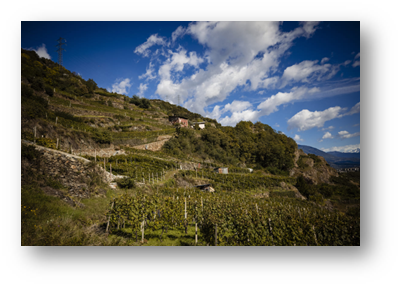
The Valtellina area is located in the north of Italy, near Bergamo, Como and Bellagio, its epicenter is the city of Sondrio. The vineyards cultivated on small terraces built on steep slopes present important challenges as the difficult accessibility makes the care of the vine and the harvest complex, so much so that it is sometimes carried out with the help of helicopters to transport to the bottom of the valley the grapes harvested on the terraces, an additional effort largely repaid by the quality of the production.

Tasting the wines

Villa Walter Fontana makes white, red and sparkling wines from different ‘appellations’ like Alpi Retiche IGT, Sforzato di Valtellina DOCG, Rosso di Valtellina DOC and Nebbiolo Alpi Retiche IGT. I did a tasting with the following wines.

ALPI RETICHE IGT
This wine is a 100% Sauvignon Blanc from the Alpi Retiche IGT region. This region was established in 1995 and got the current name in 2017. The wine is assembled under controlled temperatures, no filter is used and stored for 5 months in stainless steel tanks.

RACCONTO SEGRETO 2019

TASTING NOTES:
‘This wine is as clear as the mountain air of the region were the grapes are harvested! Dusting gooseberry, exploding boxwood and incredibly fresh lemons shooting out of the glass. The northern region naturally provides the fresh acidity, this wine is very close to the New Zealand variety, incredibly well made! A supple and svelte wine without a lot of fuss.’

Memore 2019 A blend of the ‘opposites’ in white wines! This wine is a cepage between Chardonnay & Sauvignon Blanc. The production process is equal as the ‘’Racconto Segreto’’ no wood added, just made on the pureness of grapes.

Deze afbeelding heeft een leeg alt-attribuut; de bestandsnaam is image-4.png

TASTING NOTES

‘’Clear with a lightly scented nose. The wine has less acidity than the previous one. The palate is more pear and apple with less dominant lemons. Medium body with more intensity within the multilayered flavors. Fresh, voluptuous hints make this wine  more gastronomic!’’   

If you are a Piedmont wine lover, the next few red wines  should definably have your attention. The wines are made from the Chiavennasca grape, which is the native name for Nebbiolo.

Rituale 2019 Alpi Retiche IGT After a careful selection of grapes the wine ripening for 8 months in steel tanks and finally ages for 2 years in the bottle.

TASTING NOTES

‘’A clear ruby red wine with a fresh and fruity nose. Within the taste the wine has aromas of little red berries and a floral note. But overall impression is a fresh and fruity forward style which is absolutely a great match for next summer BBQ!’’

Legame 2019 Rosso di Valtellina DOC

Another 100% Chiavennasca, the local Nebbiolo, but this time with a little touch of ‘oak maturation’, due to the fact that the wine is put in large oak barrels of around 5.600 liters. Due to the large barrels the contact with the wood is low and the wood flavor is present but not too dominant. After the aging in the barrels the wine is aged for 1 year in the bottle for the final result.

TASTING NOTES

‘’The color is typically ‘Chiavennasca’, light ruby. The wine has a medium-high aroma intensity of light floral and soft small red fruit. On the palette there are red berries, cassis aroma’s, red cherries and a sweet hint of toast and cedarwood. All with well-integrated tannins, acidity and fruit is well balanced and it all finishes with a long aftertaste of plums.’’

Luci Nel Bosco 2017 – Sforzato di Valtellina DOCG

This non filtered Nebbiolo from the Valtellina DOCG is based on grapes that are dried for 2 months and aged in oak barrels for 20 months. After this the winemaker assembles the wine in stainless steel tanks and it matures for 1 year in the bottle. 

TASTING NOTES

‘’The nose of this wines is a powerful on! Fruity notes of blueberries, ripe raspberry, raisins, flowers, currants and smoky aromas are popping out of your glass. On the palette this wine has a lot of intensity (leather, licorice, nutmeg and clove) which improves the concentration. The wine can be descripted as complex and rich and doesn’t lose its fruitiness. Think of wonderful marmalade! All aromas have a lot of flavor packed and are harmonious with the acids in the wine. The tannins are vivid, but without being disturbing. Despite the high alcohol percentage, there is a pleasant mouthfeel, that’s lingers and ends with that typical ” Piemonte ” bitterness.’’

Pietra Antica 2016 Sassella Riserva Valtellina Superiore DOCG Like the Luci Nel Bosco 2017 this wine is also based on dried grapes to achieve a high sugar level for a minimum potential alcohol level of approximate 14%.

After fermentation the winemakers does not use any type of filter and the wine will go into large oak casks (similar to Legame 2019) for 24 months. After that they put the wine over in steel tanks, as the wine rest for 2 months and will be aged in bottle for a minimum aging of 1 year.

TASTING NOTES

‘’Again the typical ruby color and on the nose a refined mix of roses, vanilla and cherry. Well cohesive aromas in the nose and on the palette with additional raisins and flowers (roses), but also the typical ‘rusty’ scent, closed with old wood and light cherry. The taste is balanced, has a balance between fruit, aromas and acids. The tannins are soft and polished. The aftertaste is experienced as pleasant.’’